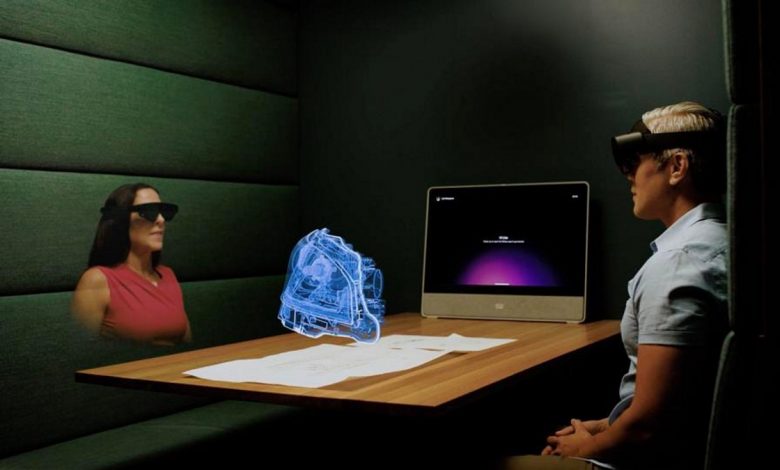
Image: Cisco Webex Hologram.
According to Gartner, only 25% of meetings will be face-to-face by 2024. With the surge in demand over the past two years marked by the pandemic, video conferencing players such as Zoom, Microsoft, Google or Cisco Webex are working hard to optimize their features.
In a hybrid work organization, Cisco, like Microsoft Mesh, represents the future of human interaction in the form of holograms. Announced last October and still in prototype stage, the Webex Hologram device promises to make video sharing more immersive. I tested it for at the Cisco Demo Center in Issy-les-Moulineaux (92).

My contact, Tobias Brodtkorb, Head of Technical Marketing for Collaboration Phones, Headsets and Room Devices, helped me remotely from Oslo to set up the device in just a few minutes. Filmed on a green screen and surrounded by a dozen cameras to capture his gestures from multiple angles, the engineer used video chat to view the prototype.
Pretty clear picture but perfect sound
As soon as I put on the helmet, I immediately notice that the glasses are not at all a hindrance to having fun. On the contrary, the helmet, which is rather loose, provides a good range of motion. This is a pretty useful feature if future Webex Hologram customers decide to present 3D objects, real or virtual, to their employees or customers. As a demonstration, Tobias Brodtkorb creates objects of all types and sizes in front of my eyes, such as a miniature car or a 3D model of a city. Objects that appear between two interlocutors can be manipulated in all directions with a simple movement of the fist.
With a book in hand, a Norwegian engineer explains the effects of “parallax”, that is, the effect of changing the position of the observer on observing an object. Simply put, it is the ability to see the cover, spine, and back cover of a book in an image simply by turning your head from right to left (which would be impossible in 2D).
The effect is impressive. On the other hand, the field of view in a VR helmet would benefit from the expansion. Indeed, it is difficult to see the hands of my interlocutor, which lie on the table without lowering their heads. Another drawback that I noticed is related to the sound: the latter comes directly from the computer next to me, from which the video conference is being broadcast. On the other hand, if there is no immersive sound yet, the visual rendering is quite high quality. The image is sharp, which allows you to limit the feeling of motion sickness.
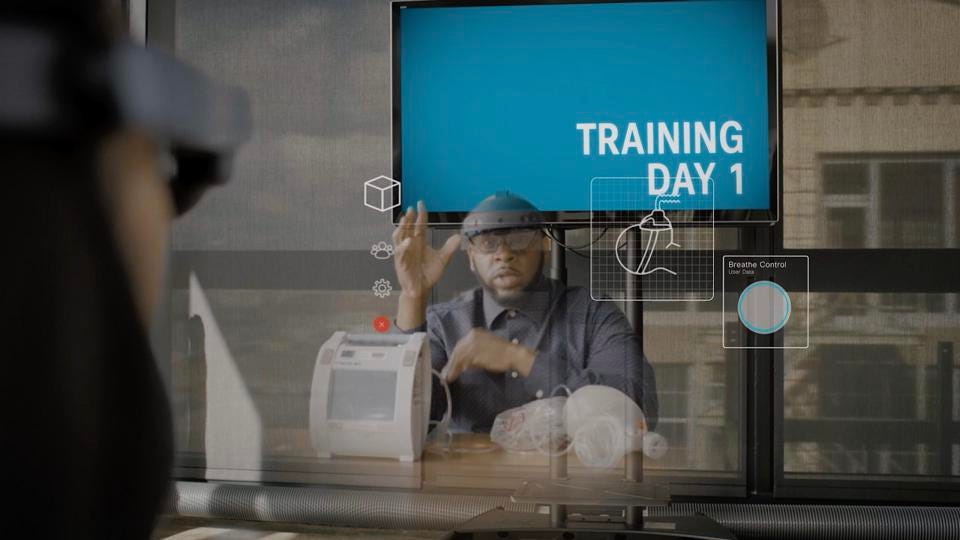
With a wave of the hand, a menu appears in front of the user, in which, in particular, it is possible to select 3D objects for integration into the scene. Image: Cisco Webex Hologram.
Realistic feelings
When removing the VR headset, it takes a few milliseconds to find spatial references in the room. This is proof that, ultimately, even in beta, immersiveness worked well. Of course, the headset itself creates a physical barrier to a truly immersive experience. But rather realistic holograms give the impression that your interlocutor is in the room in front of you.
Maybe in the future engineers will be able to find a way to do without it? If there is a video conference meeting with multiple people, will it be possible to display multiple holograms in real time? All these issues are not yet resolved, recognizes Tobias Brodtkorb.
Meanwhile, the site is up and running and early customers are starting to show interest in the technology, especially in the context of distance learning, he points out.