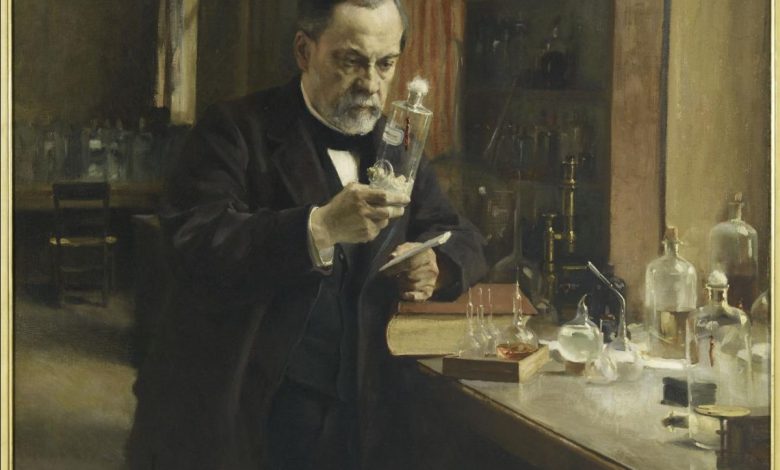
Sociologist and philosopher of science Bruno Latour said of Louis Pasteur that “he was involved in everything […] industry, agriculture, veterinary medicine and medicine. In the words of this recently deceased anthropologist of the modern world, Pasteur’s scientific career is not a straight line, a continuous and linear progression, but rather a “web of thought” that does not “run straight.” Because Pasteur’s discoveries were built at the intersection of several disciplines, when they simply did not stand at the origins of an entirely new science (quotes are taken from Bruno Latour’s book on Pasteur, reprinted by Les Preventionurs de pense en ronde).
Louis Pasteur, chronology
December 27, 1822: Louis Pasteur is born in Dole.
1843: Entered the Ecole Normale Superieure.
August 23, 1847: Defense of two doctoral dissertations, one in chemistry, the other in physics.
1847-1848: Interested in tartrate crystals, Pasteur intuitively understood molecular asymmetries.
1849: professor of chemistry at the University of Strasbourg
1853: Competition prize of the Pharmaceutical Society of Paris; he was named Chevalier of the Legion of Honor, the first honorary state award.
1854: he is appointed to the University of Lille, of which he becomes dean.
1855: Fermentation research begins.
1857: Memoirs of a fermentation called lactic.
1859-1864: Pasteur refutes the spontaneous generation hypothesis promoted by Felix Pouchet in an experiment at the Sorbonne.
1865: Start of work on diseases of silkworms.
1871: First study of beer.
1879: Research on chicken cholera and development of a vaccine.
1881: Public demonstration at Pouilly-le-Fort demonstrating the effectiveness of the anthrax vaccine.
1885: The first rabies vaccination was given to young Joseph Meister.
1888: Opening of the Pasteur Institute.
1895: Death at the Villeneuve-l’Etang estate in Marne-la-Coquette.
Pasteur discovered molecular asymmetry
According to Annick Perrault and Maxime Schwartz, authors of Pasteur: Man and Scientist, the first milestone in a successful scientific career is “a discovery that will revolutionize physics and chemistry.” This fundamental discovery in chemistry will be the first act of the discipline that Louis Pasteur initiates: stereochemistry or cosmic chemistry (where molecules are represented in three dimensions). It is also the least known discovery and the most difficult for a beginner to understand.
Louis Pasteur was only 26 years old when he solved the following problem: why do some crystals deflect a beam of left-hand polarized light, while others do not? The crystals that Pasteur is interested in are the tartrate and paratartrate of soda and ammonia, the crystallization of the same molecule, the tartaric acid that settles at the bottom of wine bottles. They are of the same nature, have the same number of atoms. Pasteur understands that the spatial arrangement of these atoms differs from molecule to molecule.
After much observation, Pasteur comes to the conclusion that the two forms of tartrate are asymmetrical, like an object and its reflection in a mirror. There is no talk of chirality yet, but a young chemist puts forward an almost philosophical idea of the necessary asymmetry of life, suggesting that the atomic arrangement of molecules affects its properties.
Microbiology birth certificate
While studying tartrate crystals as a chemist, Louis Pasteur encountered the fermentation of one of them in contact with a mould. Appointed dean of the University of Lille in 1854, he was called upon by the local beetroot distilleries. Alcohol production varies in quality and it is a matter of understanding and controlling the process that will result in efficient alcoholic fermentation.
Fermentation has been known for a long time. Artisans are involved in the process of fermentation, that is, the introduction of “enzymes” to make bread, cheeses, wines and beer. But on a scientific level, what are these enzymes? Some thought that they appeared in the process of decomposition. Louis Pasteur, on the other hand, shows that in the case of beet spirit, alcoholic fermentation takes place thanks to a living organism, “sourdough”.
This enzyme must act alone without any other element foreign to the process. It is necessary to prepare a sterile medium by bringing it to a boil and then inoculating it with an uncontaminated starter culture. This preparation of a sterile medium will be “the source of all microbiological engineering”. This boiling sterilization process finds industrial application and progeny under the name of pasteurization.
Pasteur proves that every type of fermentation is the result of the action of microorganisms still unknown to scientists at that time. There is one for lactic acid fermentation, used in cheese making, other than the one that activates alcoholic fermentation, or even the acetic one, which turns wine into vinegar. Each of his discoveries will find industrial applications in the sugar industry, brewing, vinegar production and viticulture. By understanding fermentation, the chemist Pasteur placed himself at the service of biology… and industry.
Pasteur refutes the theory of spontaneous generation
Pasteur’s work on fermentation overturns a very old theory from Greek antiquity: the theory of spontaneous generation. For the stuttering biology of the 19th century, this explanation satisfies contemporaries for explaining the development of organisms through the processes of putrefaction, the transformation of food through fermentation, or even the creation of living beings on Earth.
This thesis was taken up by the scientist Felix Pouchet, who published the result of his own experiments “Heterogeny or a treatise on spontaneous generation”. Pasteur conducts a long series of experiments in his laboratory to demonstrate the existence of microorganisms in the air that pollute the organic environment. The debate has been going on for several years and has attracted scholars, the public and the political world. Far from the image of the scientist hiding in his ivory tower, the scientist here demonstrates his penchant for explanation and for what is not yet called scientific popularization.
Helping silkworms
In 1865, Jean-Baptiste Dumas, his former chemistry teacher turned senator for Gard, assigned Pasteur a mission: to understand the cause of the hecatomb of silkworms on silk farms in southern France. National production, which rose to a record high of 26,000 tons in 1853, dropped to 7,500 tons three years later.
Pasteur is completely new to this field, he knows nothing about the growth cycle of the silkworm. His initial preliminary research led him to 1870 on the trail of two diseases, flachery and pebrin. He recommends containment and asepsis techniques for trusses to preserve them the first time. And his recommendations for the second point to the principle of hereditary diseases, pebrin is a disease that is transmitted from generation to generation.
Pasteur, Koch and coal
The world of silkworm farms - silkworm farms - gave Pasteur his first exposure to animal diseases. With the publication in 1976 of the work of the German physician Robert Koch, Pasteur’s research allowed a little more study of these infectious pathologies. Koch demonstrated that anthrax, a zoonotic disease (also transmitted to humans) that affects herds of cows and sheep, is caused by the microbe Bacillus anthracis. Pasteur, irritated by the German advance and emboldened by his anti-German nationalism, then carried out his own experiments to discover a possible flaw in Koch’s work, and came to the same results.
There is an ongoing but fruitful rivalry between the two men. The joint work of Pasteur and Koch provides the first proof of a link between a bacterium and an infectious disease, “the first experimental proof of the germ theory”. Koch later identified the cholera bacillus in India and then tuberculosis in 1882.
Microbes with attenuated virulence become vaccines
The year 1877 marks the beginning of the most celebrated period of Pasteur’s career: the development of vaccines and the beginning of immunology. In the same year, he isolated several bacteria: staphylococcus aureus, streptococcus, and pneumococcus. The following year, Italian and French veterinarians discovered the bacterium that causes fowl cholera, or fowl cholera, a devastating disease that ravages poultry farms. Pasteur can culture the embryo and reproduce it in vitro. In 1879, by inoculating this attenuated microbe into chickens and then again confronting them with a virulent version, he developed what he would later call a vaccine, after Edward Jenner, who discovered in the 18th century that it was possible to protect oneself from smallpox. by inoculation of a weakened form of vaccinia.
This was followed by vaccinations against anthrax in sheep in 1881 and red mullet in pork. On May 5, 1881, Pasteur staged the first grafting of a flock of sheep in front of a crowd gathered in Pouilly-le-Fort. The demonstration becomes a public event in which politicians, arts and scientists take part.
Rabies vaccine
Why did Pasteur decide to study rabies? According to biographers Annick Perrault and Maxime Schwartz, “overcoming such a terrifying illness means giving your work extraordinary publicity.” The disease resulting from the bites of sick animals is not common, but affects public opinion with vivid symptoms and death. This time it is no longer a bacterium, but a virus, which Pasteur cannot know because there is not yet a microscope with high enough resolution to detect it. He multiplies experiments on dogs. The rabbit as an animal model turns out to be less risky for experiments. The rodent is used to store this microbe that we can’t see. Pasteur manages to obtain attenuated forms that are used to vaccinate dogs.
Human testing of the vaccine would be done by chance, at the request of the mother of 9-year-old Josef Meister, in June 1885. She would then be introduced to Jean-Baptiste Jupil, a young shepherd of 15, in September of that year. Both will be rescued and hundreds of other people from all over the country and abroad will follow.
This is the crowning achievement of an aging pastor who proposes the creation of a research and teaching institute. The Pasteur Institute will open in 1888.
Readings recommended by Sciences et Avenir:
- Pastor: a man and a scientist. Annick Perrault, Maxime Schwartz Paris. Tallandier, 2022. 240 p.
- Pasteur: Science, style, age. Bruno Latour. Troubleshooters of Circular Thinking, 2022. 230 p.
- Louis Pasteur. Pure science in the service of industry / Guillaume Carnino. - Social Movement, 2014/3 (No. 248), pp. 9-26. Article dedicated to Pasteur and his connections with industry. This gives the scientist objects for reflection, motivates his research and the solution of industrial production problems.