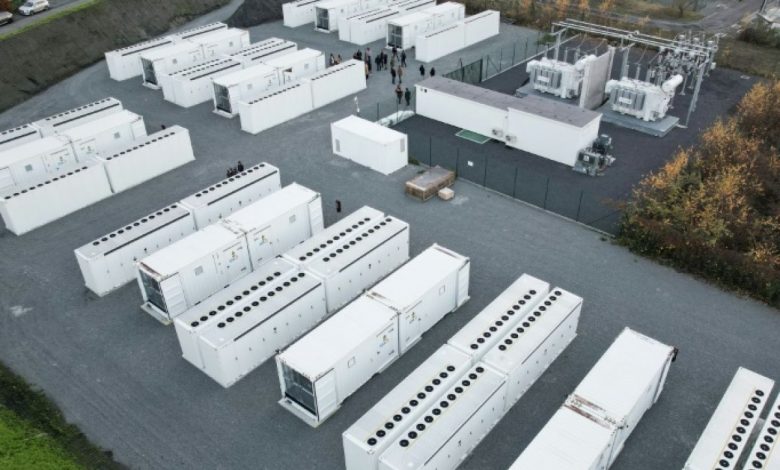
They are not very spectacular a priori, and yet these white containers, installed on the outskirts of a small Belgian town, form the largest electric storage in continental Europe, capable of meeting the peak demand in the country without the need for gas or oil.
Well hidden behind a grassy embankment, a plot connected to the public grid now contributes to Belgium’s electricity reserve and thus regulates the frequency in the European grid, which is all interconnected.
With 100 megawatt-hours (MWh) of storage, equivalent to the needs of 8,000 households, it performs a stabilizing function that is largely performed by oil or gas-fired power plants today.
To move away from fossil fuels, “batteries are critical because they allow better integration of renewable energy sources, mitigating the negative effects of their volatility” and optimizing infrastructure, explains Jean-Philippe Deckers, head of Elia, the operator. Belgian high voltage network.
“It will play an important role in the energy transition and is part of our vision,” he added as he opened the premises on Thursday in Deux Acrens, between Brussels and Tournai.
Connected to a high-voltage line, 40 containers filled with Nevada-made Tesla lithium-ion batteries store and receive electricity from the grid on demand.
Lithium-ion technology was chosen because of its maturity, explains Michael Kudiser, managing director of Corsica Sole, the photovoltaic and storage pioneer that developed and operates the facility: “We know these batteries will last at least ten years.”
Noise-absorbing mounds protect neighbors from the hum of fans. According to him, the lesser evil is “next to the aircraft engine”, which had to be used to mobilize a nearby fuel depot. This tank should be deposited soon.
- Key to the transition -
“If we want to separate ourselves from gas, which is causing electricity prices to plummet, we need storage,” emphasizes Mr. Kudizer, who recalls the peculiarities of the European electricity market, whose prices today are practically unrelated to gas prices, when demand is strong.
But beyond that, storage and generation of electricity will be one of the main themes of the energy transition, because it will drive the development of renewable energy sources, smoothing out fluctuations in their power during one day when a cloud passes overhead. solar panels or the wind subsides…
Storage also allows energy produced during periods of low demand to be stored and recovered during periods of high demand. The same during the week to store it on Sunday, the day of lower consumption.
The UK, an island heavily dependent on green energy, has understood this well and is well ahead of storage.
“A world without fossil fuels is needed, and a 100% renewable world is possible. But if we want a lot of renewable energy, we will also need a lot of storage,” sums up Mr. Kudaizer.
But it’s expensive: 33 million euros for the Deux-Acren facility, 80% of which is for batteries, funded without subsidies. It will take about 7 years to make it profitable, with sales in the electricity market.
In order to be able to build it in less than a year, management company Mirova, a sustainability subsidiary of Natixis-BPCE and already a shareholder in Corsica Sole, advanced the amount before Edmond de Rothschild’s bank arrived.
“The need for renewable energy development has never been greater in this period of energy crisis, the need for energy sovereignty and the fight against climate issues, and this cannot be done without major investments,” comments Rafael Lans, Mirova.
However, at this stage, it is out of the question to consider storage in this form of volumes that are too large: too expensive, emphasize energy players who, like Corsica Sole, are rather betting on hydrogen in order to be able to store more energy from wind and sun.