In 2017, a closed-loop experiment conducted by a group of researchers from various American universities (Vanderbilt in Nashville, Rutgers in Camden and Arizona in Tucson) showed that by inserting several self-driving cars into dense traffic, these modified behaviors of motorists around them, in particular their speed, up to eliminating the “accordion” effect, when vehicles spend their time accelerating as soon as the lane in front of them is cleared to travel several tens of meters. .
The test, conducted with 22 traditional vehicles and an autonomous vehicle, led to another discovery: reduced fuel consumption by all vehicles involved.
Serious technological problems
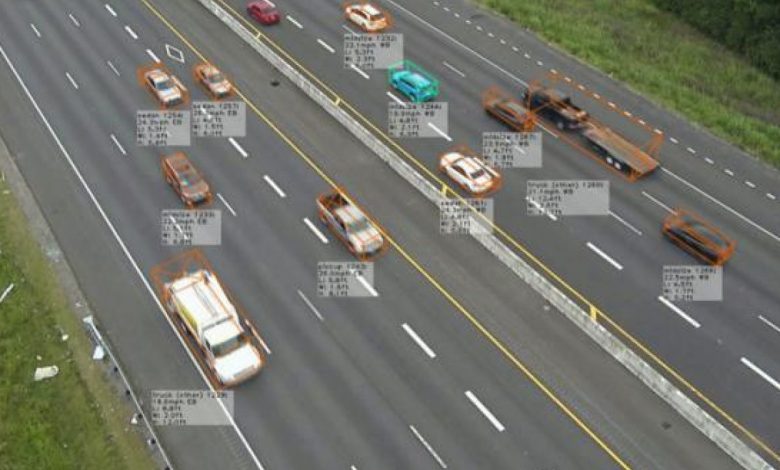
It was to test these lessons that the researchers created the Circles consortium, with other academic partners, car manufacturers, and Tennessee authorities. No more closed test sites this time: 97 autonomous vehicles were put into actual traffic on Interstate 24 in Nashville in a 6.4 km (4-mile) stretch that they traveled back and forth on. Or the biggest real world test of autonomous vehicles.
This happened from 14 to 18 November 2022 from 5:00 to 10:30. Therefore, the results are not yet available, but the technological stakes are high, since traditional drivers, by definition, do not use any research protocol. Experience has already shown the difficulties associated with real driving conditions when autonomous and traditional vehicles coexist. “We had to pay a lot more attention to how people drive and imagine the most extreme scenarios,” says Amory Hayat, a researcher at the Cermics lab at Ecole des Ponts ParisTech and a member of the team.
Algorithms trained with reinforcement learning
Traffic regulation was done by playing the speed and acceleration of autonomous cars, which calculated the data according to the length of the lane that was being cleared in front of them. The vehicle algorithms were trained on the simulator by reinforcement learning (trial and error) by integrating aggregated traffic state information measured downstream. “The accordion effect occurs because drivers restart too quickly,” the researcher continues. Therefore, we tried to understand what speed was correct (to limit this effect - approx. ed.), Through a cartographic interface like Google Maps. which lets the self-driving vehicle know what’s going to happen.”
Since the idea is to influence human behavior on the road through the behavior of robots (driverless cars), a delicate balance needs to be found between creating effects and not destabilizing traffic. Therefore, it was necessary to ensure that autonomous vehicles did not restart too slowly, in any case slower than the ideal value, so as not to disturb the drivers. Amaury Hayat was able to see this while sitting in one of the unmanned vehicles (everyone had someone on board for safety): “When the road is cleared, it suddenly seems that there is no more traffic or not. go right away. And it can last a good minute.”
Reduce fuel consumption by 10%
If, in a situation, researchers could empirically observe that traffic is changing, the average motorist would be more prone to misunderstanding, even nervousness, feeling “blocked” by others.
Since the motorway was equipped with high-definition cameras (294 in total) at the top of the masts to monitor the tracks, traffic video streams will be used to evaluate the impact of the device on energy consumption. Again, speed and acceleration data for each car will be used for this calculation. Ultimately, the team hopes that the presence of autonomous vehicles in road traffic can provide energy savings of at least 10% for all vehicles present.