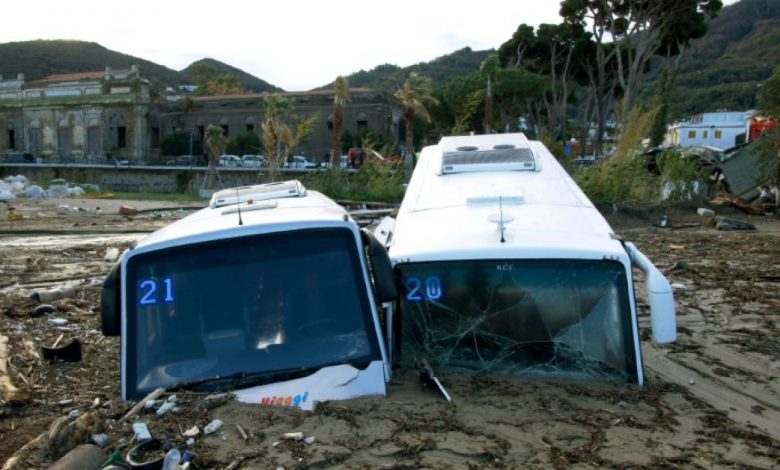
Ischia, an island in southern Italy that was hit by a deadly landslide on November 26, has become a victim of its geographic location and weather, as well as a massive phenomenon of illegal urbanization that affects many regions of the country and increases the risk of natural disasters, experts and politicians say.
The drama “Ischia is a declared tragedy with specific causes and responsibility: the irresponsible management of a territory that, with the accelerating effects of climate change, has turned into a ticking time bomb,” condemned the Italian branch of the World Fund. for nature (WWF) after the tragedy.
“It is very hypocritical to mourn the victims now, continuing to build where we should not,” criticizes the NGO.
According to experts, legal or illegal urbanization, combined with deforestation, prevents the soil from absorbing rainfall water, as happened in Casamicciola Terme, an area on the island where heavy rains soaked the ground overlooking the resort and led to a murderous landslide.
Offensive structures are a constant subject of controversy on the other side of the Alps, the deadly natural disasters that often hit the peninsula are regularly associated with this disaster.
“The sad and widespread phenomenon of improper construction is, because it is the cause or one of the causes of disasters, a topic that can no longer be avoided,” Civil Protection Minister Nello Musumeci admitted on Thursday.
This is even more true of Ischia, an island of volcanic origin in the Gulf of Naples, whose soils are particularly unstable.
“49% of the island of Ischia is classified as areas with a high or very high risk of landslides, more than 13,000 people live in these areas,” Environment Minister Gilberto Picetto Fratin said on Wednesday.
An even more alarming figure: according to the latest report from the Higher Institute for Environment and Research (ISPRA), 93.9% of Italian municipalities are at risk of landslides, floods or coastal erosion.
“It doesn’t take an expert to understand that illegal construction is a risk multiplier that goes far beyond the people who live there,” the WWF said in a statement.
- “Swiss clinic” -
Faced with anarchist structures, amnesty is most often chosen in Italy. But the procedure is so long and complicated that it often takes several years to receive a response from the administration.
In Ischia alone, 27,000 requests for amnesty have been made in recent years, according to media reports.
And when justice finally decides to demolish an unscrupulous building, its inhabitants often find ways to get around this decision.
Quote from the Turin daily La Stampa Aldo De Chiara, a retired prosecutor in Naples who specializes in fighting illegal construction, analyzes the schemes used.
The occupants of the illegal home “brought in the children of the whole family in a broad sense, because having minors justifies not demolishing,” he says.
Another technique was also used: upon arrival, the police “find out in illegal premises, on the veranda or in the dining room, patients connected to infusions, as in a Swiss clinic.”
For Sergio Piro, a 47-year-old hotel owner who runs three establishments, including one in Casamicciola Terme, illegal construction is only part of the problem.
“When there is a landslide in the north of Italy, we talk about climate change, when in the south we talk about illegal construction,” he told AFP.
“It is true that there are illegal buildings, but in this particular case, this is a section of the mountain that came off due to the fact that preventive work was not carried out, in particular the repair of drainage channels,” he notes.
“I heard a big noise as this flood of rocks and earth hit the first houses,” shyly the hotel owner, who wants to point out that the rest of the island of Ischia, which lives mainly from tourism, is doing quite well.