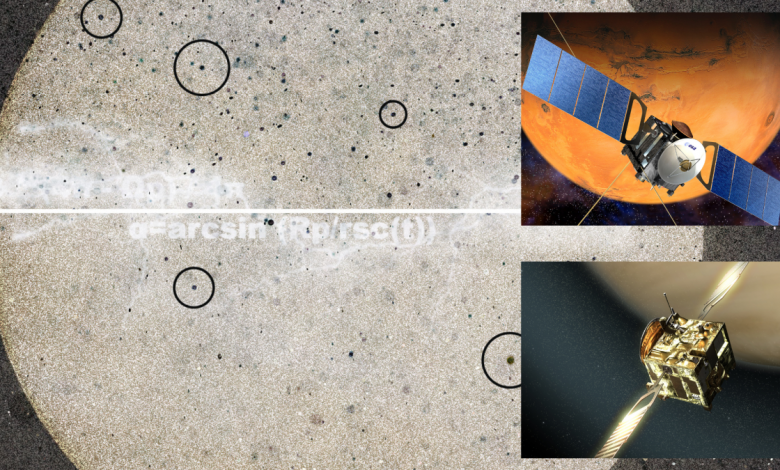
Measurements taken near Earth’s neighbors Mars and Venus show a struggle between high-energy cosmic rays from outside the Solar System and the influence of the Sun within the Solar System.
In the new study, scientists compared data collected by similar ASPERA plasma sensors on the Mars Express and Venus Express spacecraft with the number of sunspots visible on the surface of the Sun. The results showed that peaks of high activity in the 11-year solar cycle suppressed cosmic rays, which are high-energy particles that travel through space at nearly the speed of light. And understanding cosmic rays could be vital to future space exploration because these high-energy particles can damage spacecraft electronics and even astronauts’ DNA.
“The study shows a number of valuable insights that can be gleaned from what is actually the background count information collected by the ASPERA instruments,” said Yoshifumi Futaana, a scientist at the Swedish Institute of Space Physics and lead author of the new study. statement. “Understanding the various relationships between cosmic rays and the solar cycle, planetary atmospheres, and spacecraft instrumentation is very important for future robotic and human research missions.”
On the subject: A mysterious region of the sun shines in a new photo from the world’s largest solar telescope
The European Space Agency’s (ESA) Mars Express spacecraft was launched in 2003 and remains in orbit around the Red Planet, while the agency’s Venus Express orbited the second planet from the Sun between 2006 and 2014, providing scientists with 17 years of data from Mars and eight from Venus. The researchers also included cosmic ray measurements taken on Earth by the Thule Neutron Monitor in Greenland.
The team then split the data into three-month periods to analyze the amount of cosmic rays over those periods, reducing the impact of sporadic solar events such as flares and coronal mass ejections.
Data from all three planets showed that cosmic ray detection decreased when the Sun’s solar cycle 24 activity peaked around April 2014. However, the Red Planet data showed a nine-month delay between maximum sunspot count and minimum in cosmic ray detection around Mars.
“Previous studies have shown that there is a delay of several months between solar activity and the behavior of cosmic rays on Earth and Mars,” Futaana said. “Our results support this, and also provide additional evidence that Solar Cycle 24 was a bit unusual, possibly due to a long solar minimum between Cycles 23 and 24, or relatively low activity during Cycle 24. “.
(Cycle 25 is currently gaining momentum and is expected to peak around 2025.)
The data collected by Venus Express was harder to analyze than data from Earth or Mars because the way the data was processed aboard the spacecraft changed in 2010.
In addition, although Venus Express and Mars Express use the same cosmic ray counting instrument, separate ASPERA plasma sensors are adapted to the very different conditions of the second and fourth planets of the solar system. This prevented a direct comparison of the number of cosmic rays on the two planets.
Futaana and his team also studied how the detected cosmic rays varied over the course of several hours as each spacecraft orbited its planet. This work has determined that cosmic rays cannot reach a region beyond Mars that is larger than the planet itself, although researchers are not yet sure why.
The team’s research is described in a paper published Monday (December 5) in the Astrophysical Journal.
Follow us on Twitter @Spacedotcom or on Facebook.