A major study claims that bitcoin mining is 52% greener. We are far from the often quoted figures from the University of Cambridge.
Offline bitcoin mining
So far, we have had two major studies of Bitcoin’s energy consumption. Those owned by the Cambridge Center for Alternative Finance (CCAF) and the Bitcoin Mining Council (BMC).
According to the first estimates, the share of renewable energy sources in the composition of bitcoin miners is 37.6%. For BMC, it’s more like 59.4%.
The BMC study is based on data provided by North American miners, who account for 46% of the hashrate. The remaining 54% is a simple extrapolation of the US energy balance.
There is also a Digiconomist website. The latter belongs to Alex de Vries, an official at the Dutch central bank… His unreliable data, unfortunately, gets too often in Bloomberg, The Guardian, NY Times, etc.
Therefore, faced with a large discrepancy in numbers, we applaud this third study by Daniel Batten.
Moreover, unlike the CCAF, D. Batten also takes into account minors established “out of the network”. That is, those “who have their own power plant or who have entered into a contract with an energy company.”
This addon is a game changer as 52.8% of mining is done offline! Moreover, autonomous energy is mostly carbon-free (65.5%).
Size difference
This new information suggests that Bitcoin:
- Uses a minimum of 52.2% renewable energy.
- Increases its share of renewable energy by 4.50% every year.
The forecast of 4.5% is based on current mining projects and the fact that the global energy mix is becoming greener by an average of 0.7% per year.
Conversely, incomplete estimates from Cambridge suggest that Bitcoin will only use 37.6% of renewable energy.
Here is a graphical summary of the report:
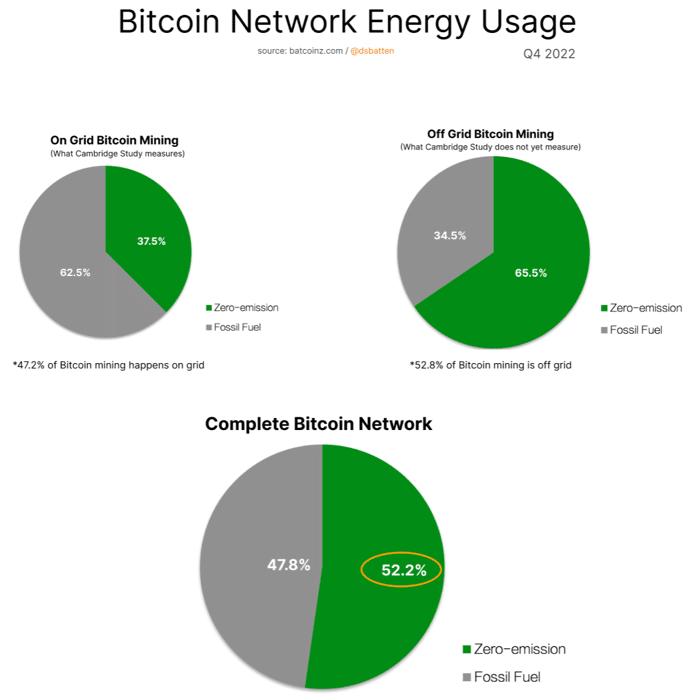
It should be noted that miners using coal are not installed directly on coal-fired power plants. Coal is simply the main source of electricity worldwide (36.7%).
One of the bad students is Stronghold. The miner uses 165 MW of carbon energy. Or about 2.3% of the hashrate.
On the other side of the spectrum, we have 17 miners (16% of the hashrate) that use 100% or nearly renewable energy:
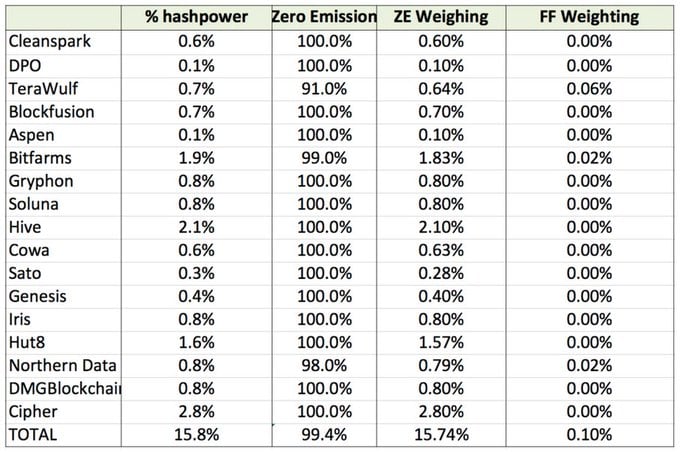
These estimates are not yet perfect. In particular, there is a lack of information about Kazakhstan, where many miners work on anthracite. The share of Chinese mining is also unclear.
China still accounted for 21% of the hash rate in January 2022, according to CCAF. In this report, Daniel Batten suggested that hydropower accounts for only 1/3 of the Chinese miner mix.
It should also be noted that this study does not take into account the weakening of the greenhouse effect when miners are connected to methane flares. Or 2.36% of the hashrate.
The reason is that electricity is generated by burning methane (which is emitted from flares) into CO2. However, the greenhouse effect of CO2 is much less significant than that of methane.
Get a digest of news in the world of cryptocurrencies by subscribing to our new service daily and weekly so you don’t miss any important Cointribune news!

Journalist reporting on the bitcoin revolution. My articles look at bitcoin through a geopolitical, economic, and libertarian lens.