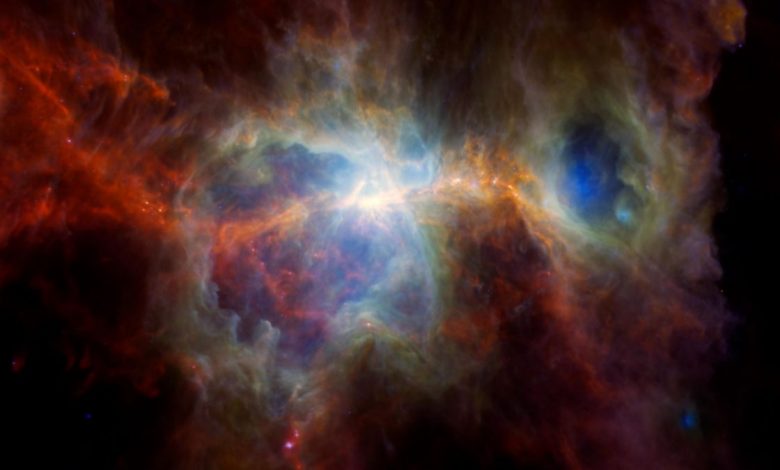
A stunning new image of the stellar nursery tells a cosmic tale of death and rebirth.
A photograph of the Orion Nebula, the closest star-forming region to Earth, captures the transformation taking place as massive stars die in the region, leaving the building blocks of the next generation of stellar objects.
The image was created using data from NASA’s now-retired Spitzer Space Telescope; wide-angle infrared viewer, now known as NEOWISE; and the European Space Agency’s Herschel Space Observatory, which is now retired.
RELATED: Star nursery details in Sword of Orion blown up by stars

An infrared image of the Orion Nebula showing hotspots marking the birth of new stars. (Image credit: ESA/NASA/JPL-Caltech)
Located in the constellation of Orion and named after a Greek mythological hunter killed by the sting of a scorpion, the dust cloud has a creation story that is perhaps equally worthy of a place in mythology.
In the star forming region, which is 30 to 40 light-years wide and about 1,300 light-years away, there are two giant caverns carved out by giant stars, which are themselves obscured by a thick layer of dust in the image. Because these massive stars emit millions of times more radiation than the Sun, this radiation breaks up dust particles, creating giant voids that dominate the nebula.
The remaining dust is blown away by the wind from nebula stars and by supernovae, huge cosmic explosions that occur when massive stars die.
In the image, patches of warm dust are marked with blue light, while slightly colder dust at the edges of the caves is colored green. The red color in the image comes from cold dust that reaches minus 440 degrees Fahrenheit (minus 260 degrees Celsius); these regions are located mainly on the outer edges of the dust cloud, away from regions where young and hot stars form.
Between the two giant cavities of the Orion Nebula, orange threads are strung, illustrating the story of death and rebirth as told by the image. These filaments contain material from supernova explosions that could merge into the next generation of massive stars, NASA officials said in a statement.
Eventually, these newborn stars will begin to emit massive amounts of radiation, dispersing the dust clouds that gave birth to them and reshaping the region again before they die in supernovae, and again enrich the region with heavy elements for the next generation of stars.
The transformation story told by the image also extends to the telescopes behind its creation. In 2020, the Spitzer Space Telescope was decommissioned after 17 years of infrared observations of the universe. During its existence, Spitzer has probed the temperature of extrasolar planets, discovered a giant ring around Saturn, and helped discover some of the most distant galaxies in the universe.
Launched in 2009, the WISE spacecraft went into hibernation after just two years. However, in 2013, NASA granted the telescope a second mission to search for near-Earth asteroids. The mission, renamed NEOWISE, is still operational today and has been used to set limits on the number, orbits, sizes, and composition of asteroids scattered throughout the solar system.
Follow us on Twitter @Spacedotcom or on Facebook.