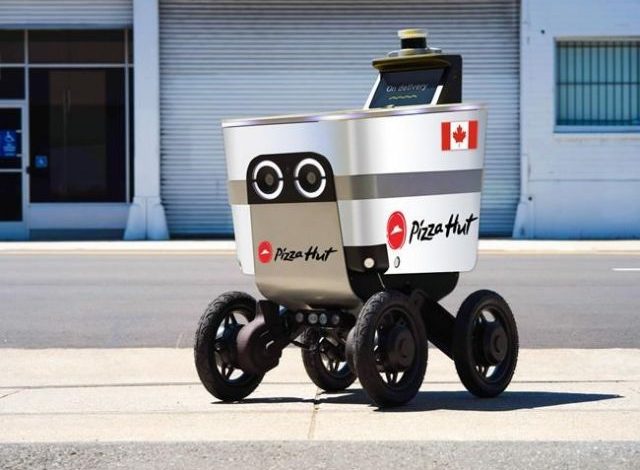
Photo: Canadian press
An autonomous robot delivers pizza from Pizza Hut in Vancouver.
When customers in downtown Vancouver placed their orders at Pizza Hut in September, many pies landed on their doorstep without a courier.
Instead, visitors are greeted by Angie, Hugo, or Raja, self-driving robots resembling radiators on four wheels with glowing eyes. They walked down the sidewalk to shoppers who used unique codes to open the lids and display their food.
The value proposition for Serve Robotics — part of Uber’s 2020 acquisition of food delivery company Postmates, which has created a trio and fleet of zero-emission robots — is simple: with low restaurant profits, labor shortages, and climate change concerns, “why move two-pound burritos to two-ton car?
Several other robotic delivery companies have a similar philosophy, but their path to ubiquity faces many obstacles.
Delivery robots have been banned in some major cities such as Toronto, which allege they pose a risk to people with limited mobility or low vision, as well as the elderly and children. Cyclists already hate e-scooters on bike lanes and don’t want robots.
“They get a lot of attention from pedestrians when they’re on the sidewalk because they can’t see much and people are happy to see them, but as their use continues to grow, it can cause big congestion on already narrow sidewalks. said Prabhyot Gill, associate retail partner at McKinsey & Co.
There are also concerns that autonomous robots or robots piloted by offshore employees could take away jobs from carriers.
Vancouver-born Surf CEO Ali Kashani sees criticism as a natural part of innovation, as even the bicycle, when it was invented, was seen by many as divisive.
He tried to allay fears by making sure his robots (Kashani didn’t say how many) were ringing and flashing lights to warn those around him. It is equipped with automatic collision avoidance, vehicle collision avoidance and emergency braking.
Ultimately, he believes they are a win-win because they cut traffic, stimulate local commerce, and help merchants get groceries to consumers at more affordable prices.
The environment also benefits as Serve replaces delivery vehicles. Kashani estimates that almost half of deliveries across the country are less than 4.5 miles, and 90% of them are by car. Approximately 2% of global greenhouse gas emissions worldwide come from people using personal vehicles for household and business purchases.
“There are many reasons to replace our machines with these robots as soon as possible, but we have no reason to make anyone an enemy,” Kashani said.
Knowing how much resistance new ideas can face, Cerf makes sure to contact governments and authorities before launching them in a city, even if they don’t have legislation allowing or banning bots.
However, David Lepofsky, chairman of the Accessibility Law Alliance for Ontarians with Disabilities, said these robots and humans cannot coexist because they would still pose a tripping hazard and, worse, they could be used to transportation of contraband or explosives.
He insists that the fight he and others have waged to keep bots off the sidewalk is not an attack on innovation.
“We don’t deny people their rights,” he said. “We have a pizza delivery method that we’ve had since we’ve had pizza deliveries. It’s called people. »
Manish Dhanker, director of customer experience at Pizza Hut Canada, agrees pizza delivery is not worth the risk, but says his company only partnered with Surf after the robots made thousands of trips without injury.
Service robots have been delivering goods to the nearby Pizza Hut at 1725 Robson Street for two weeks now, but the pilot has been “childishly excited” by customers, with a 95 percent satisfaction rating.
Dhankhar says the goal was to modernize pizza delivery, not cut costs. Couriers delivered about the same as before the use of bots.
But Pizza Hut is not ready to use bots all the time.
“We want to know more,” he said. “What happens when you place this in the snowy areas of Saskatchewan, and what happens when it’s freezing rain? »
Another question: what happens when cities don’t welcome robots?
Tiny Mile, the company behind a series of pink heart-eyed robots named Jeffrey, knows the answer.
Years after Jeffrey started delivering delivery services like Foodora to Toronto, Lepofsky and others have argued that people can be incapacitated by faulty or stuck devices or unable to quickly detect their presence.
Last December, the Toronto City Council voted to ban the use of muscle-only devices on sidewalks, bike lanes and footpaths until the province implements a pilot project for such devices.
Jeffrey was later spotted in Ottawa, before city officials confirmed that such robots were not allowed there either, and the Canadian Tiny Mile became completely extinct.
“We were on the brink of bankruptcy,” said Ignacio Tartafull, CEO of Tiny Mile.
It’s a miracle we survived. »
To save Jeffrey’s life, Tiny Mile headed to Florida and North Carolina.
“It was love at first sight,” said Tartaful. “We’ve been talking to cities and they’ve basically competed to make this happen. »
He believes the admiration will spread as the cost of delivering robots - now around $1 - drops to 10 cents over the next seven years.
“It will probably be a few years before we get it in big cities, but in the long run there is no doubt about it, because the technology is there, it works, and we can deliver it on time and for much less money,” he said. . said.
As for Serve, it is currently focused on Los Angeles, but Kashani said its mission is to get 5% of delivery vehicles off the road over the next five years.
“But I certainly hope that if I fast forward a decade or two, these robots will serve more local freight traffic … until we stop being so dependent on cars. »