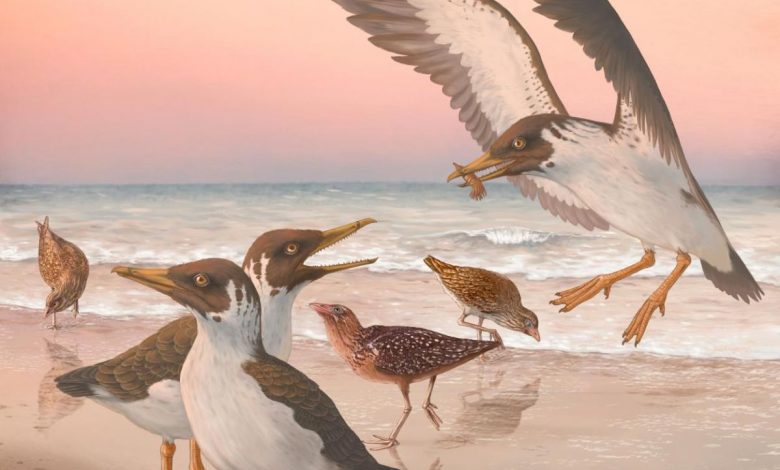
Janavis finalidens flew over the European skies 67 million years ago. Its fossil, originating in northeastern Belgium, was in the Natural History Museum in Maastricht, the Netherlands, when it was examined by a team from the University of Cambridge. “Janavis toothy bird of the late dinosaur era. It was a large sea animal, about the size of a seagull and capable of weighing up to 1.5 kg,” Daniel Field, one of the authors of the study published about him in the journal Nature, told Science et Avenir.
A question of taste
Today’s birds are divided into two groups: paleognaths, which, like cassowaries or ostriches, have a rigid skull and do not have a movable joint at the level of the palate. And the neognathians, which make up about 90% of modern birds and have an articulated skull with a movable palate and hanging jaws. Since the dinosaur ancestors of birds (theropod dinosaurs) also share the characteristics of paleognaths, evolutionists have believed for more than a century that the latter appeared prematurely and gave birth to neognaths after the crisis that ended the age of the dinosaurs 66 million years ago. However, this hypothesis has been difficult to test because the fragile elements of the palace are rarely well preserved in the fossil record.
But some specimens resist better than others. Such is the case with the fossil studied by Daniel Field, which was discovered about twenty years ago in a quarry. At that time, a summary examination carried out concluded that it consists of the bones of the spine, wings and legs. “However, this fossil has never been studied in detail, so we decided to re-examine it,” says the researcher. “Using the scanner, we were able to look inside the rock surrounding the fossil and extract 3D digital models of the bones. This new study showed that many bones had previously been misidentified. Among them was a small bone that we identified as the Palatine. The anatomy of this bone indicates that the bird must have exhibited a sophisticated ability to move its upper jaw independently of the rest of the skull, which was previously thought to be a characteristic much later in bird evolution,” explains Daniel. Field.
Description of bones found in two toothed birds of the group Ichthyornites. Credits: Dr. Juan Benito / Dr. Daniel Field / University of Cambridge.
Revisit the history of birds?
The 3D models show that the palace Janavis Finals almost indistinguishable from living land and water birds belonging to the neognaths. This suggests that they evolved first and that paleognaths descended from them. This is contrary to current assumptions for almost centuries. Should we therefore revise the entire family tree of birds? “I don’t think the family tree of modern birds needs to be revised, but rather we need to rethink how the specialized beaks that characterize the major groups of modern birds have evolved. Today we understand that the strong, relatively rigid beaks of ostriches and their relatives evolved from the more agile beaks seen in other modern birds, which refutes long-held assumptions about these characteristics,” Field replies.
The study also shows that Janavis finalidens is the closest known relative of the iconic Ichthyornis, a bird that lived between 100 and 66 million years ago. This bird has been known for a long time from fragmentary fossils and was already studied by Charles Darwin in the 1870s. It is undoubtedly one of the first birds to have a real beak, serrated like the Janavis.