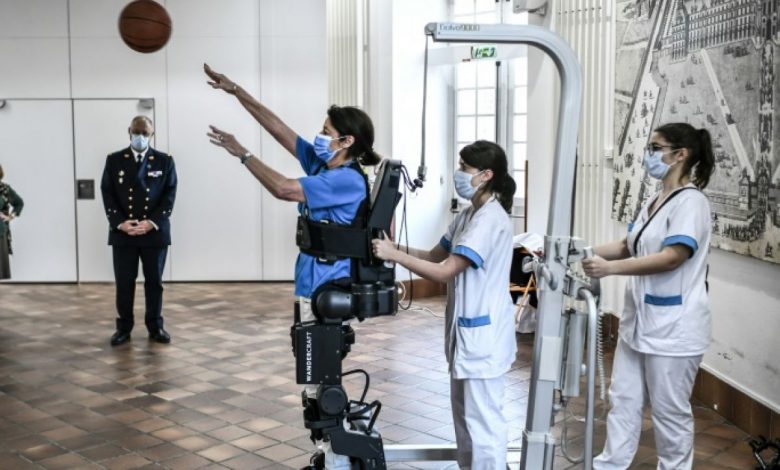
Allowing wounded soldiers nailed to their chair to get up and walk: this is now possible at the National Institute of the Invalides in Paris, which has just equipped itself with an exoskeleton, an innovative rehabilitation tool.
At this state-of-the-art facility that specializes in caring for the wounded and disabled in war, Dr. Lawrence Meilhan, a rehabilitation physician, donned this walking robot for a demonstration.
After fitting the straps around her chest, she transitions from a sitting to a standing position and starts walking under the guidance of the robot.
His lower limbs are assisted by two mechanical structures that double his skeleton.
Designed to balance the patient while standing, the Atalante exoskeleton can also be used to perform strengthening exercises for the lower extremities, trunk and upper extremities.
“For patients who can walk again, this saves rehabilitation time,” explains Dr. Meilhan.
But for those who never can, the benefits are also plentiful: “Standing upright has been shown to help combat osteoporosis or the risk of fractures. It may also improve transit or urinary disorders, respiratory capacity and endurance,” she said.
Nurses prepare an exoskeleton for presentation at the Les Invalides hospital on November 9, 2022 in Paris (AFP - STEPHANE DE SAKUTIN)
Since its launch three years ago, about twenty hospitals in France have invested in the robot, developed by French startup Wandercraft.
If some competitors in the world produce others, then “our model is the only one that balances itself and does not require the use of crutches to stabilize,” says co-founder Jean-Louis Constant.
The cost of the exoskeleton: 220,000 euros. The Solidarité Défense Association, which accompanies the military and civilian personnel of the armies, offered it to the National Institute of the Invalids before the summer.
“After a training phase for medical personnel at the beginning of the academic year, he is now working,” welcomes his president, former minister Jean-Marie Bockel.
- “At eye level” -
Every year, between 250 and 300 French soldiers are injured during the fighting. Through this acquisition, their care pathways “will be improved,” the association predicts.
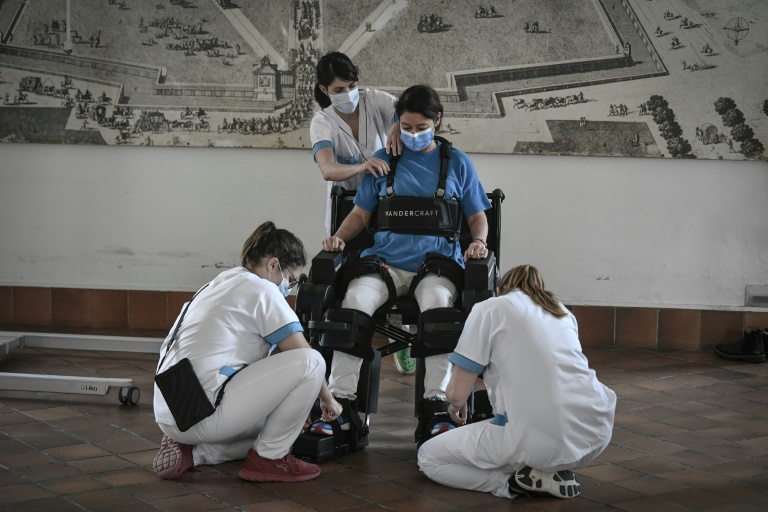 Nurses install an exoskeleton on a doctor for a demonstration at a hospital for the disabled on November 9, 2022 in Paris (AFP - STEPHANE DE SAKUTIN)
The device must be secured by hanging from ceiling rails or a “patient lift” system.
“At least two people are watching the patient,” Lawrence Meilhan explains. But not all the wounded will be able to use it: “there are restrictions on size, weight, articular amplitude.” “We also check that there is no bone loss to limit the risk of fractures,” she explains.
So Cesar (a pseudonym), a 35-year-old former soldier who was left paralyzed after a mission in the Sahel ten years ago, now suffers from osteoporosis, which limits his ability to use an exoskeleton.
“If he existed during my rehabilitation…”, he regrets.
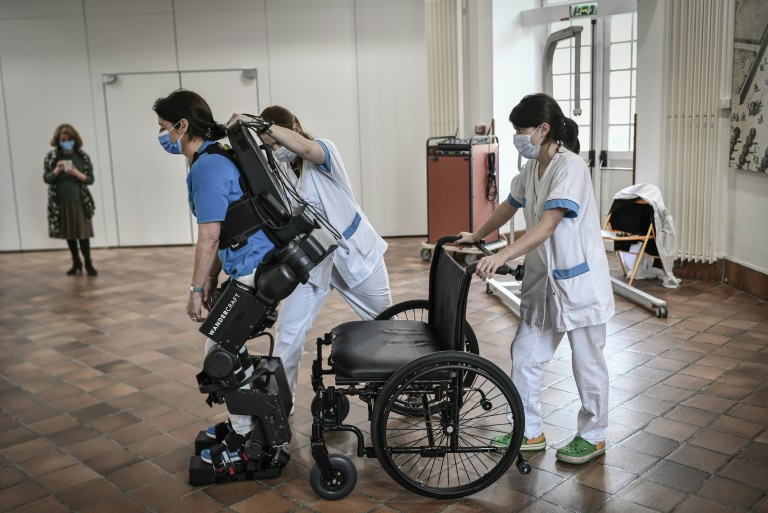 A doctor tests an exoskeleton during a presentation at the Invalides Hospital on November 9, 2022 in Paris (AFP – STEPHANE DE SAKUTIN)
After living nine years in the Les Invalides, he, however, once was able to verify this: “What made me different was that I was at the height of people, appearance and was no longer in a position of physical inferiority,” he admits.
Wheelchair-bound Virginie Dubos, 37, after a surfing accident five years ago, also insists on the “psychological” aspect: “The very fact that you’re standing face to face with someone is amazing!”
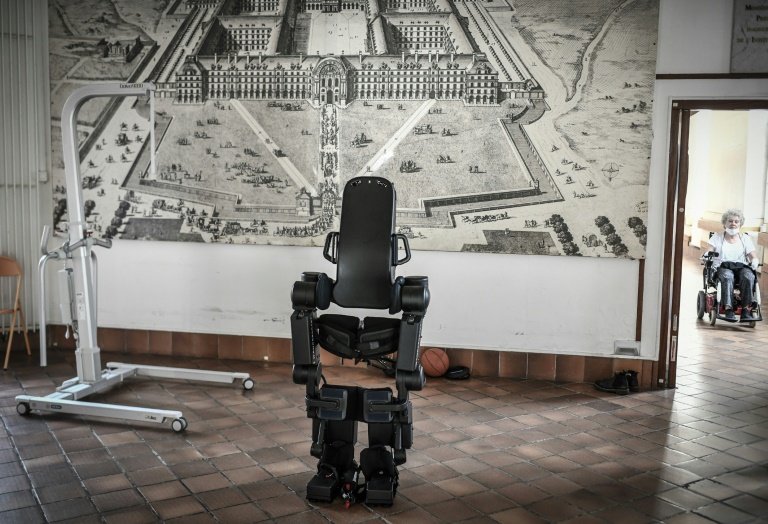 The exoskeleton was handed over to the Hospital for the Disabled on November 9, 2022 in Paris (AFP - STEPHANE DE SAKUTIN)
For this “citizen”, who attends sessions of physiotherapy exercises in the day hospital of the House of Disabled Persons, walking with an exoskeleton completes rehabilitation well. “The first time I tried it, it made me a little tired, but over time, I felt that it strengthened my muscles and cardio,” she says. Each weekly session has become “my bubble of pleasure,” she adds.