Business reopening and reduced PCR test requirements: Health regulations are being relaxed in a growing number of Chinese cities, including Beijing and Shanghai, a week after historic angry demonstrations.
In the capital of 22 million, many shops reopened as early as this weekend, and residents can once again use public transport on Monday without showing a negative PCR test result in less than 48 hours.
The same measure in Shanghai, where this obligation has also been lifted for access to certain public spaces such as parks and tourist attractions.
The financial metropolis of 25 million people was shut down hard in the spring after the emergence of the Covid outbreak, a highly unpopular measure that also affected the country’s economy.
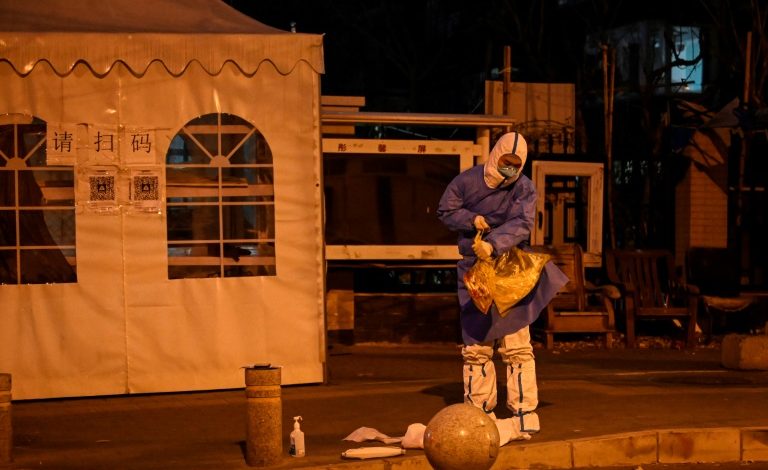
Medical personnel in Beijing, December 2, 2022 (AFP/Archive - Jade GAO)
A week ago, that anger, which had simmered for months against a strict zero-Covid policy, erupted into demonstrations in a dozen Chinese cities in an unprecedented scale since the pro-democracy mobilization in Tiananmen Square in 1989.
The policy, in place for almost three years, disrupted residents’ daily lives, repeating lockdowns and large-scale PCR tests nearly every day through 2022.
- “Flexibility” -
These demonstrations, led in part by students, quickly became political, with some demanding the resignation of President Xi Jinping.
In response, authorities have since begun easing restrictions, a move that the World Health Organization (WHO) has welcomed.
The Chinese president himself acknowledged that the less lethal Omicron variant “opens the way for greater flexibility in restrictions,” according to European Council President Charles Michel, who visited Beijing last week, a European official said.
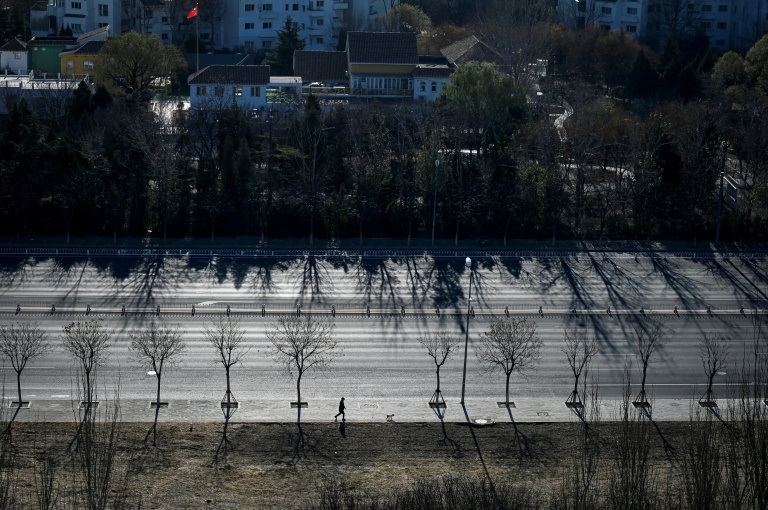 A man wearing a mask walks his dog in Beijing, December 1, 2022 (AFP/Archive - WANG Zhao)
Last month, China released a list of measures aimed at “optimizing” its health policy and minimizing its socioeconomic impact, but local implementation has varied widely.
While the Chinese economy was set to post one of its worst growth rates in four decades this year, getting out of Covid Zero is a delicate operation.
“Finding a balance between the Covid-19 response and economic growth has once again become a central issue,” said economist Wang Zhe, who commented on poor service-sector activity on Monday.
“The central government has recently issued clear demands for further optimization (health policy). But how local authorities will or will not implement these instructions will be of key importance.”
- Cabins dismantled -
The city of Hangzhou, near Shanghai, has announced a halt to large-scale PCR tests, which are the norm for almost the entire country, except for those in contact with nursing homes, schools and kindergartens.
Supermarkets, hotels, restaurants and ski resorts reopened in Urumqi, the northwest capital of Xinjiang, where a deadly fire sparked nationwide protests and medical restrictions are blamed for hindering relief efforts.
The city of four million has been hit by one of the longest lockdowns in the country, in place in some places since early August.
In Wuhan (center), where the first cases of Covid-19 were detected in December 2019, and in Shandong (east), public transport has also stopped requiring passengers to take negative PCR tests.
In Zhengzhou (center), authorities have lifted inspection requirements for public places and transportation, as well as residential buildings.
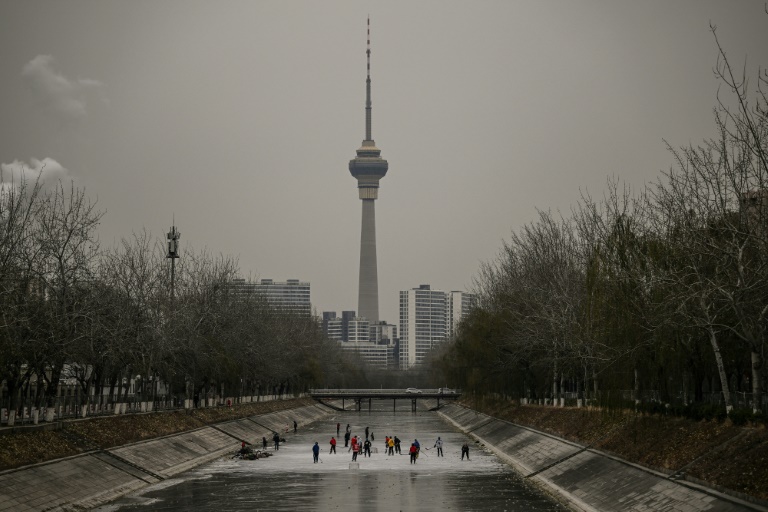 Beijing, December 2, 2022 (AFP/Archive - Noel SELIS)
Although many of the test booths have been dismantled in recent days, long lines against those who remained were visible this weekend, especially in Beijing and Shenzhen (south), as testing is still needed in many places.
“Students cannot go to school without a negative test within 24 hours,” said a Weibo user, a kind of Chinese Twitter.
“So what’s the point of shutting down test benches without abolishing all testing requirements everywhere?”
On Monday, the number of cases dropped to 29,724, mostly asymptomatic, a tiny number compared to China’s population of 1.4 billion.