This article is taken from the monthly journal Sciences et Avenir - La Recherche #910 of December 2022.
Is there a black hole the size of a tennis ball in our solar system? In any case, this very hypothesis was put forward very seriously by British and American researchers to explain many misunderstood phenomena in the Kuiper belt.
This vast region of millions of icy bodies extends beyond the orbit of Neptune to a distance of 30 to 55 astronomical units (AU, the astronomical unit corresponding to the distance between the Earth and the Sun, or about 150 million kilometers). The best known of these trans-Neptunian objects is the dwarf planet Pluto, discovered in 1930. But since 1992, other planetoids have been seen there, named Eris, Sedna, Haumea, Makemake …
And as discoveries piled up, scientists’ misunderstandings grew: Models really struggle to explain some eccentric orbits, like Sedna’s, the clustering of certain objects, or even trajectories perpendicular to the planetary disk. All these anomalies become more predictable if a massive body on the outer edge of the Kuiper belt is introduced into the model.
Back in 2014, American scientists from the Carnegie Institution in Washington (USA) thus put forward a hypothesis about the presence of a fifth giant planet with a mass of five to ten times the Earth, crossing it at a distance of 300 to 1000 AU. This celestial body, called the Ninth Planet, could have been ejected from the inner part of the solar system at the beginning of its formation.
Or be a rogue planet, captured by the gravitational pull of our star. But to date, no trace of the ninth planet has been found. This invisibility can be explained if this body is in fact not a planet, but a black hole, a star hidden by definition, because it does not emit any radiation …
This is the hypothesis of astrophysicists Jakub Scholz from the University of Durham (UK) and James Unwin from the University of Illinois at Chicago (USA). A black hole five times the mass of the Earth would, for example, have a diameter equal to the length of an index finger, making it almost invisible. According to the researchers, the existence of such an object could also explain the set of gravitational anomalies observed by the Ogle (Optical Gravitational Lensing Experiment), an experiment at Warsaw University (Poland) to detect gravitational microlenses.
Two possible interpretations of the detected anomalies
These light bending phenomena occur when a very massive object in the foreground distorts and brightens the stars behind it. “Ogla’s experiment recorded six ultra-short microlensing events occurring over periods of 0.1 to 0.3 days,” explain Jakub Scholz and James Unwin. These events correspond to the lensing effect of objects with masses from 0.5 to 20 Earth masses. They can be interpreted. as the product of an unknown population of rogue planets or primordial black holes.” According to the researchers, both hypotheses are equally likely.
But what distinguishes a primordial black hole from a classical black hole? His origin. A standard black hole, called an astrophysical one, results from the death of a star. At the end of his life, when he has used up all his radioactive material, the radiation pressure that has expanded his atmosphere is reduced. Then the gravitational force inside it takes over, and if the star has a mass of at least 1.4 times the mass of the Sun, it collapses on itself, forming a black hole. Most of the stellar black holes created in this way have a mass between 5 and 10 solar masses. Then they increase in size, growing together with the surrounding substance. But models show that even if such a star develops in an environment rich in stars and gas, its mass cannot exceed a thousand solar masses, given the time that has elapsed since the Big Bang.
How, then, to explain the supermassive black holes observed in almost all large galaxies, including the Milky Way, and reaching millions and even billions of times the mass of our star? The existence of so-called primordial black holes, theorized in 1971 by British astrophysicists Stephen Hawking and Bernard Carr, solves this puzzle. At least on paper.
“This population of black holes should have formed a few fractions of a second after the Big Bang,” explains Vincent Vennin, a researcher in the physics laboratory at the Ecole d’Ecole Paris. Then the Universe consisted of plasma, inside which fluctuations formed clumps, from which stars and galaxies later arose … Dense clumps could also collapse into black holes. after inflation. That is, at the end of the rapid expansion phase that would have allowed the universe to expand significantly, between 10-36 and 10-33 seconds after the Big Bang.
Physics explains that there is a linear relationship between the mass of primordial black holes and the time since the Big Bang: black holes created at the end of inflation will have a mass of one gram, while those born one second after the beginning of the universe will have mass 100,000 times the mass of the Sun!
“Quantum fluctuations arose randomly and uniformly,” says Vincent Vennin. This means that the primordial black holes are distributed uniformly at first. But then they are attracted to each other, collect in packets, merge.” An evolutionary process that, on the scale of the age of the universe, would reach the mass of supermassive black holes anchored in the cores of large galaxies.
If the early universe did indeed spawn cohorts of black holes of all sizes, that could also explain another mystery of cosmology, the mystery of “dark matter,” which represents 85% of all matter in the universe. Because visible matter alone does not explain the gravitational coherence of rotating galaxies, whose stars, according to the laws of physics, must fly apart under the influence of centrifugal force.
Thus, matter of an unknown nature is apparently concentrated in the outer halo of galaxies, in this boundary region, which extends beyond the last settlements of old stars and globular clusters, referred to the galactic outskirts. The importance of dark matter, which is assumed to be concentrated in this halo, helps to explain the speed of rotation of galaxies. But what is it made of? Primordial black holes, proposed by several physicists in the 1990s, abandoned in the early 2000s, in particular in favor of the search for exotic particles. A search that has remained futile to this day.
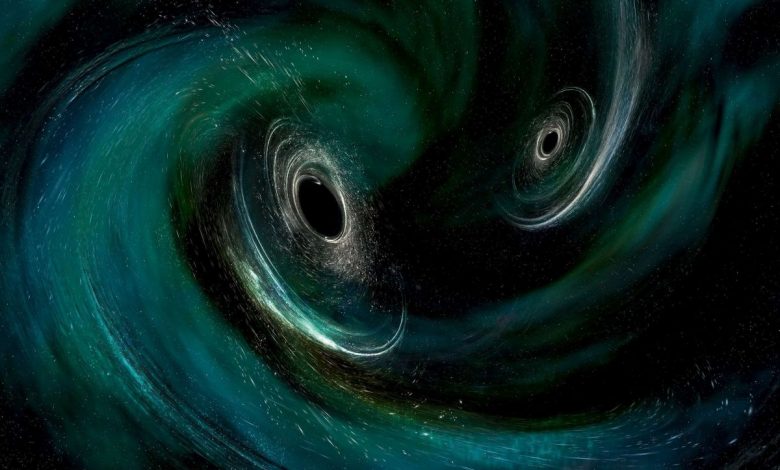
In addition, when in 2015 the Ligo and Virgo observatories, located respectively in the United States and Italy, first detected gravitational waves generated by the merger of two black holes, interest in primitive objects renewed. “For a long time, black holes were considered exotic objects, and primordial black holes added the exotic to the exotic,” emphasizes Vincent Vennin. “Now that we’ve managed to prove their existence, we don’t know if we’ll find astrophysical or primordial black holes in the presence.”
To date, more than 100 black holes have been characterized by energy waves emitted when they merge and floated to us within space-time, like waves on the surface of water. But these objects intrigue scientists. “We expected to find black holes 10 to 15 times the size of the sun,” explains Sebastien Kless, a physicist at the Free University of Brussels (Belgium). forbidden by supernova models, and the spin - proper rotation - of observable black holes is close to zero, which is expected from a primordial black hole … “
Seeds of the first stars and galaxies
The only way to be sure of this is to observe a black hole with a mass less than 1.4 times the mass of the Sun, an object that cannot be created from a star. Current instruments are not sensitive enough, and we have to wait for the commissioning, scheduled for 2034, of the European space laser interferometer Lisa. Moreover, black holes formed in the first seconds of the existence of the Universe could be the embryos of the first stars and galaxies.
Thus, these gravitational “engines” accelerated the collapse of the clouds of dust and gas that filled the universe during the first million years after the Big Bang. If so, these episodes could be observed with NASA’s new James Webb Space Telescope (JWST), which has been in orbit since December 25, 2021. As for our tiny black hole in the solar system, it could give away its presence if it swallow some substance. in the future, an event unfortunately rare in these cold and desolate regions of the Kuiper belt.
When black holes evaporate
At every moment, pairs of particles and antiparticles are born in the Universe, which immediately annihilate. But at the edge of a black hole, things can happen differently. This dense star actually bends space-time so much that it creates a horizon.
When a particle-antiparticle pair is created at this limit, one member of the pair can be swallowed up by the black hole while the other member moves away from it. Since annihilation is no longer possible, the black hole emits radiation that gradually causes it to lose mass.
This evaporation phenomenon is barely noticeable for a very massive black hole, but can lead to the complete disappearance of lighter black holes. Since the Big Bang 13.7 billion years ago, all primordial black holes with a mass of less than 1011 kg have already evaporated. The least massive black holes remaining today (1012 kg) have the mass of a mountain compressed into the volume of a hydrogen atomic nucleus!
“It was to test this evaporation phenomenon, called “Hawking radiation,” that the British physicist Stephen Hawking put forward the theory of the existence of very small mass primordial holes,” notes Sebastien Kless, a physicist at the Free University of Brussels, Belgium). Observing the evaporation of black holes would be a reliable way to prove the existence of primordial black holes.