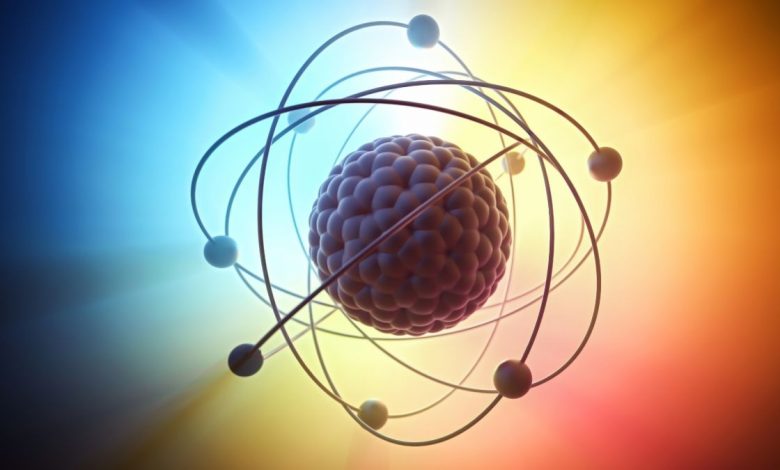
Neutrons are tiny subatomic particles that, together with protons, form the nucleus of an atom.
While the number of protons determines which element an atom is, the number of neutrons in a nucleus can vary, resulting in different isotopes of an element. For example, ordinary hydrogen contains one proton and no neutrons, but the isotopes of hydrogen, deuterium and tritium, have one and two neutrons, respectively, along with a proton.
Neutrons are composite particles made up of three smaller elementary particles called quarks, held together by the Strong force. In particular, the neutron contains one “up” and two “down” quarks. Particles made up of three quarks are called baryons, and hence baryons make up all of the baryon “visible” matter in the universe.
Related: What is a Theory of Everything?
Who discovered neutrons?
After Ernest Rutherford (using the gold leaf experiment of Ernest Marsden and Hans Geiger) discovered in 1911 that atoms have a nucleus, and nine years later found that atomic nuclei are at least partially composed of protons, the discovery of the neutron in 1932 James Chadwick naturally followed.
The idea that there must be something else in the nucleus of an atom came about because the number of protons did not match the atomic weight of the atom. For example, an oxygen atom contains 8 protons but has an atomic weight of 16, suggesting that it contains 8 other particles. However, these mysterious particles must be electrically neutral, since atoms usually have no overall electrical charge (the negative charge of the electrons balances the positive charge of the protons).
At that time, various scientists were experimenting with alpha particles, which is another name for helium nuclei, by bombarding a material made from beryllium with a stream of alpha particles. When the alpha particles collided with the beryllium atoms, they produced mysterious particles that seemed to originate inside the beryllium atoms. Chadwick went further with these experiments and saw that when the mysterious particles hit a target made of paraffin, they knocked out high-energy protons. To do this, Chadwick reasoned, the mysterious particles must have more or less the same mass as the proton. Chadwick declared the neutron to be this mysterious particle and in 1935 received the Nobel Prize for his discovery.
Neutrons: mass and charge
As their name suggests, neutrons are electrically neutral, so they have no charge. Their mass is 1.008 times that of a proton - in other words, it is about 0.1% heavier.
Neutrons do not like to exist on their own outside the nucleus. The Strong Force bond energy between them and the protons in the nucleus keeps them stable, but when on their own, they undergo beta decay after about 15 minutes, becoming a proton, an electron, and an antineutrino.
Albert Einstein, in his famous equation E = mc2, said that mass and energy are equivalent. Although the masses of the neutron and proton differ only slightly, this small difference means that the neutron has more mass and therefore more energy than the proton and electron combined. That is why when a neutron decays, a proton and an electron are formed.
Isotopes and radioactivity
An isotope is a type of element that has more neutrons. For example, at the beginning of this article, we gave an example of the hydrogen isotopes of deuterium and tritium, which have 1 and 2 extra neutrons, respectively. Some isotopes are stable, such as deuterium. Others are unstable and inevitably undergo radioactive decay. Tritium is unstable—its half-life is about 12 years (half-life is the time it takes, on average, for half a given amount of an isotope, such as tritium, to decay), but other isotopes decay much faster, in minutes, seconds, or even fractions of a second.
Neutrons are also important tools in nuclear reactions, in particular in causing a chain reaction. The neutrons absorbed by atomic nuclei create unstable isotopes, which then undergo nuclear fission (splitting into two smaller daughter nuclei of other elements). For example, when uranium-235 absorbs an extra neutron, it becomes unstable and breaks apart, releasing energy in the process.
Neutrons also play an important role in the creation of heavy elements in massive stars through a mechanism known as the r-process, where the “r” stands for “fast”. This process was first detailed in the famous Nobel Prize-winning B2FH paper by Margaret and Geoffrey Burbidge, William Fowler, and Fred Hoyle, which described the origin of elements through stellar nucleosynthesis—the creation of elements by stars.

Our Sun produces the elements oxygen, nitrogen and carbon as a result of nuclear fusion reactions. (Image credit: NASA) (will open in a new tab)
Stars like the Sun can produce the elements oxygen, nitrogen, and carbon through nuclear fusion reactions. More massive stars can continue to exist and create shells of increasingly heavier elements up to iron-56 in the star’s core. At this point, the reactions require more energy to be put into them to fuse elements heavier than iron than what is actually produced by these reactions, so these reactions stop, energy production stops, and the core of the star collapses, causing an explosion. supernova. And it is during an incredibly powerful supernova explosion that conditions can become extreme enough to release many free neutrons in a short period of time.
In a supernova explosion, the atomic nuclei are then able to capture all of these free neutrons before they all decay (which is why it is described as fast) to trigger r-process nucleosynthesis. Once the nuclei are filled with neutrons, they become unstable and undergo beta decay, turning those extra neutrons into protons. The addition of these protons changes the type of element that the nucleus is, hence the way to create new heavy elements such as gold, platinum and other precious metals. The gold in your jewelry was formed billions of years ago by the rapid neutron capture of a supernova!
neutron stars

Neutron stars are composed almost entirely of neutrons. (Image credit: Petris via Getty Images) (will open in a new tab)
As we have seen, only under the most extreme conditions can neutrons survive outside of atomic nuclei, and there are very few places in the universe more extreme than neutron stars. As their name suggests, these are objects made up almost entirely of neutrons.
Neutron stars are what is left of the core of a star after it has undergone core collapse and exploded as a supernova. The explosion may have blown away the outer layers of the star, but the shrinking core was left intact.
In the absence of nuclear reactions to generate energy to counteract gravity, the mass of the nucleus is so great that it undergoes a catastrophic gravitational collapse in which the gravitational pressure is great enough for protons and electrons to overcome the electrostatic force between them and collide with each other. , merging to form neutrons in a kind of inverse beta decay. Almost all the atoms in the nucleus turn into neutrons, which is why we call the result a neutron star. They are small, only 6-12 miles (10-20 km) across, but contain all the mass of the dead star’s core.
The most massive neutron star ever discovered has 2.35 times the mass of our Sun, all crammed into a tiny volume. If you could scoop up a spoonful of material from the surface of a neutron star, that spoonful would weigh as much as a mountain on Earth!
Binary neutron star mergers, which show up as kilonovae and their gravitational waves, are also sites of abundant r-process nucleosynthesis. The kilonova of the two merging binary stars that released the gravitational wave burst GW 170817 produced 16,000 times the mass of the Earth in the form of heavy r-process elements, including ten Earth masses of gold and platinum, which is extraordinary!
Follow Keith Cooper on Twitter @21stCenturySETI. Follow us on Twitter @Spacedotcom and on Facebook.
Additional Resources
Learn more about neutrons at the US Department of Energy (will open in a new tab). Find out how neutrons are being used in condensed matter experiments with the UK Science and Technology Facilities Council. (will open in a new tab). Read the famous B2FH article (will open in a new tab) about creating elements inside stars by capturing neutrons.
Bibliography
Particle Physics, Brian R. Martin (2011, One-World Publications) (will open in a new tab)
The Cambridge Encyclopedia of Stars by James R. Kahler (2006, Cambridge University Press) (will open in a new tab):
Collins Online Dictionary of Physics (2007, Collins) (will open in a new tab)
This month in the history of physics. American Physical Society Sites, APS News, Volume 16, Number 5. Accessed December 1, 2022, https://www.aps.org/publications/apsnews/200705/physicshistory.cfm. (will open in a new tab)
neutron decay. ScienceDirect. Accessed December 1, 2022, https://www.sciencedirect.com/topics/physics-and-astronomy/neutron-decay. (will open in a new tab)